Sunday, February 17, 2013

Southern Exposure Seed Exchange

It looks like we found a new seed company to try. A colleague made us aware of the Southern Exposure Seed Exchange. They are a Baker Creek-esque seed company based in Mineral, Virginia that focuses on gmo-free, untreated, open pollinated seeds suited to the inland plains of the mid-Atlantic (our zone, 7a) and the mid-Atlantic region writ large. They describe this area as "generally characterized by high summer heat, humidity, numerous plant diseases, uneven precipitation and occasional high temperatures in the early spring and late fall. Soils are predominately clay except in the sandy coastal areas." Add in the plagues of Egypt-magnitude insect problems we experience at the community garden and this precisely captures our growing conditions.
 2013 Catalog Cover
Am I in love? Very possibly. I am withholding judgement til we grow some of their seed, but all indications are positive. 

For starters, their catalog is lovely. Just the type of seed catalog a garden hopes to get in the middle of winter: one filled with planting and seed saving tips, planting calendars (again, for MY zone...how great is that?!), planting quick references, and great information about seed exchanges and preservation programs. It has a great mixture of plant photos and old-timey drawings. All the seed descriptions include indicators identifying varieties "especially well-suited to the Southeast," heirlooms, ecologically grown, and USDA certified organic. They are up front about the specific plant seeds they carry that are hybrids (only four of them). They even sell seed-saving supplies that are usually difficult to find, such as muslin bags and seed vials.

They have a "safe-seed" pledge that says they do not "knowingly buy or sell genetically engineered seeds or plants." I'm happy to see this. While it doesn't necessarily mean they go as far as Baker Creek does to ensure their seed is not GMO tainted (for example testing each batch of heirloom seed), it is still a far cry better than most seed companies out there. 

They are even part of the Organic Seed Growers and Trade Association (OSGATA) et al. vs Monsanto lawsuit which definitely scores them points with me. If you aren't familiar with the lawsuit, I encourage you to read about it here

Overall, I am excited to order some seed from these folks. We've been looking for some summer lettuce that can withstand our brutal June temperatures, and it looks like they have a few varieties that fit the bill. (I'm eyeing the "Jericho" which was bred for desert heat and which is "especially suited to the Southeast.") I will do a follow up post later this summer.

Tomatoes Started

We started our tomatoes on February 10th, along with some onions (see here for how we start seeds indoors). According to our garden plan we started the tomatoes a few days earlier than we planned and the onions about a month late. But whatever. We are doing this as we have a free second, which isn't often.


We started the following:
2 Cherokee Purples
1 Blondkopfchen (using the saved seed so tripled sowed it. All popped up right away)
1 Black Cherry
1 Cosoluto Genovese
1 Volunteer (also saved seed but only did one since we planned to sow more in the next go around)

Observations to date:
All of the seeds have germinated except the Cosoluto Genovese. I will give that one another day and then re-sow. The volunteer seedling is already an inch taller than the rest and is budding second leaves (the one all the way to the right in the picture). I am very excited to see how much this produces this summer since it seems to be a great example of natural (and now human) selection. I think putting the grow set up in the kitchen this year helped our germination time since the kitchen is the warmest part of our house. We put it there out of necessity, but it has worked out so far. (I cringe to think how our counter will look in 2 months though). 

Plans:
We need to set up the fan to "tickle" the seedlings so that they spread strong roots. We've done that the last two years and have been widely successful. As long as I remember to mist them once a day and turn on the lights in the morning they should grow nicely. We plan to pot these out into yogurt containers when we start the next set of tomato seedlings (early March). Stay tuned.

Wednesday, January 2, 2013

Welcome 2013!

What better way to welcome the new year than with our 2013 sowing and planting schedule?

Garden Resolutions for 2013:
  1. This year we are going to single stem our tomatoes s bit more faithfully
  2. We are going to use deep watering in all the beds
  3. We are going to rearrange at least one of our beds to make better use of space
  4. We are going to add 2 more low tunnels with row covers
  5. We are going to turn our compost more often and add more brown matter during the summer
  6. We are going to make our garden pollinator-friendly
  7. And most importantly, we are finally going to build a new garden gate!

Tentative Schedule:
For our zone (7a), the last frost date is tentatively Apr 15th (but usually comes earlier) and the last frost is October 15th.

For a list of what we may plant, see here.

January 1-15:
  • Start onions and shallots indoors

Feb 15-30:
  • Start pepper seeds and first set of tomatoes indoors
    • 2 Cherokee Purples
    • 1 Volunteer
    • 1 Blondkopfchen
    • 1 Black Cherry
    • 1 Costolute Genovese

March 1-10:
  • Direct sow lettuce, asian greens, beets, radishes, carrots, turnips, peas, and mustard
  • Re-pot first set of tomato starts 
  • Start kohlrabi and broccoli indors
  • Start second set of tomatoes indoors
    • 2 Cherokee Purple
    • 1 Costolute Genovese 
    • 1 Riesentraube
    • 2 Smudges
    • 1 Volunteer
    • 1 Black Cherry

 March 15-30:
  • Transplant broccoli and kohlrabi

April 1-8:
  • Re-pot second tomato starts indoors
  • Start herbs indoors
  • Sow 2nd planting of peas directly in the garden. 
  • Sow 2nd lettuce crop and more beets 
  • Sow chard

April 15-20:
  • Harden off and transplant first tomato and pepper starts (under tunnel)
  • Sow pumpkin, winter squash, and cucumber seeds indoors
  • Direct sow more lettuce, beets, radishes, carrots, asian greens, mustard greens
  • Transplant onions, shallots, kohlrabi, and broccoli
April 30:
  • Sow last cool-weather lettuce, wax beans, and green beans
  • Harden off and transplant pumpkins, squash, herbs, and cucumbers to the garden if the soil is well warmed (under tunnel)
May 1-15
  • Plant flowers

May 15-20: 
  • Sow 1st summer lettuce
  • Sow 2nd crop of beans and radish in garden

June 15:
  • Sow 2nd summer lettuce
July 1-14th:
  • Sow summer lettuce
  • Sow 3rd crop of beans, 4th crop of radish in garden
  • Direct sow fall beans, parsnips, kohlrabi, brussels sprouts, broccoli and radishes
  • Sow collards
 July 14-28th (10 to 12 weeks before your first frost)
  •  Direct-sow beets, carrots, leeks and scallions, along with more cool weather lettuce and radishes

July 28th-Aug 11th (8 to 10 weeks before your killing frost)

  • Direct-sow lettuce, turnips, spinach, mustard, pakchoi and other Asian greens
  • Sow more radishes

Aug 11th- 25th (6 to 8 weeks before first frost)
  • Sow more lettuce, mustard, and beets beneath the protective tunnel

Sunday, December 30, 2012

2013 Seed Collection

Here is what is in our seed collection for 2013. I will update this periodically though the year as my will power fails me, and I buy more seeds than my garden can ever accommodate. The * indicates the seeds we usually start indoors.

Storage: We store our seeds in old peanut butter jars or a ziploc and keep it in a crisper drawer in our fridge.

Beans:
Bean, Brittle Wax (Bush Wax) -OP- Burpee -52 days  (1 1/2 pkgs)
Bean, Burpee's Stringless Green Pod- F1 - Burpee- 50days (Bush habit)
Bean, Climbing French - SSE -OP-65-75 days (pole habit)
Brassicas:           
Broccoli, Calabrese Green Sprouting, Baker Creek
*Brussels Sprouts- Baker Creek-OP 
Kohlrabi, Early White Vienna – Baker Creek - OP
Pakchoi, Choko Baby  – John Scheepers – 45 – 55 days
Climbers (Peas and Cukes):
Pea, Shelling (Burpeeana Early)-Burpee - 63 days
Pea, Super Sugar Snap (edible podded) - Burpee – 64 days
Cucumber, Burpless Beauty – Burpee – F1- 60 days
Cucumber, Bush Champion - Burpee - F1 - 55 days 58-65 days
Cucumber, Japanese Climbing- SSE -OP
Gourds and Squash/Pumpkins:
Winter Squash, Early Butternut (bush habit) – John Scheepers – 82 days
Potimarron - SSE -85-95 days (saw this in Germany and loved it. SSE is the only place I know of that sells it)
Pumpkin, Early Sweet Sugar Pie--Burpee 90 days
Herbs:
*Basil, Greek - Burpee Fordhook Collection                        
*Basil, Lime- Burpee Fordhook Collection            
*Basil, Genovese – Baker Creek
*Basil, Sweet - Burpee
*Bee Balm, Lemon – Baker Creek            
Chamomile, Organic German ( but actually roman)-Garden's Alive-OP- Perennial
Chamomile, Bodegold – John Scheepers - Perennial
Chamomile, Organic German - Garden's Alive
Chervil, Curled -Burpee Fordhook Collection  
Chives, Common- Burpee-Perennial
Chives, Common - American Seed
Chives, Common - Burpee Signature 
Chives, Garlic - Burpee                   
*Cilantro, Slo-bolt – Baker Creek
Cilantro, American Seed            
Lavender, True - Burpee
*Majoram - Ferry Morse             
*Oregano – Burpee
Parsley, Single Italian Plain Leafed - Burpee
*Sage, Broad Leaf -Jiffy Smart Start
*Tarragon  -Ferry Morse
*Thyme, Common -  Burpee   
Nightshade:
*Cherry Tomato, Blondkopfchen-SSE-OP- 75-80 days (yellow)
*Cherry Tomato, Black Cherry- Baker Creek – OP (black/purple)
*Cherry Tomato, Riesentraube- Baker Creek -OP (red)
*Cherry Tomato, Super Sweet 100 –Burpee- F1-70 days (red)
*Tomato, Cherokee Purple – Baker Creek – OP (black/purple)
*Tomato, Costoluto Genovese- Baker Creek-OP (red)
*Tomato, Green Zebra-Baker Creek - OP    (green)
*Tomato, Orange Fleshed Purple Smudge- Baker Creek – OP -(multi)
*Tomato, Thessaloniki- Baker Creek-OP-60-80 days (red)
*Tomato, "2012 Volunteer" cherry/Roma mix (red)
*Pepper, Beaver Dam – SSE – OP-80 days from transplant (mildly hot)
*Pepper, Black Hungarian – SSE – OP 70-80 days from transplant (medium hot)
*Pepper, Garden Sunshine – SSE – OP-80-100 days from transplant (sweet)
*Pepper, Red Mini Bell- Baker Creek (sweet)
 Onions:
Bunching Onions, Evergreen Long White -Burpee- Perennial
Onion, Nebuka Bunching- Plantation- 60-65 days
Onion, Yellow Granex - John Scheepers - 150 days 
Onion, Red of Florence, Baker Creek
Leek, American Flag--Ferry Morse
Shallots, Ambition – John Scheepers--100 days
Root Vegetables:
Beets, Yellow Cylindrical, Baker Creek
Beets, Chioggia, Baker Creek
Beets, Cylindra - Burpee - 60 days
Carrot, Nantes Half Long - Burpee - 70 days
Carrot, Short n' Sweet Chantenay - Burpee - 68 days
Parsnip, Harris Model, Baker Creek
Radish, Asian Watermelon - Burpee - 35 days
Radish, Gourmet Rainbow Mix (Flamboyant French Breakfast (red/white long taper), Fuego (red round), Hailstone (white round), Helios Yellow (round), Pink Celebration (round), Plum Purple (round), Roodkapje (red/white round) and White Icicle (long taper)  - John Scheeper- 23-30 days 
Turnip, Purple Top White Globe – SSE -  45-65 days
Turnip, Golden Globe - Baker Creek
Salad:
Asian Greens, Mizuna, Baker Creek
Asian Greens, Tatsoi, Baker Creek
Lettuce, Butter Beauty (butterhead) - Burpee - 75 days
Lettuce, Burpee Bib (butterhead)- Burpee 75 days
Lettuce, Parris Island Romaine – Ferry Morse – OP-68 days
Lettuce, Simpson Elite (looseleaf) –Burpee –OP- 48 days
Lettuce, Tennis Ball (butterhead)- SSE
Lettuce Mix, Lovely Lettuce Mesclun Blend (Little Gem Baby Romaine, Curly Tango, Cheeky Red Lolla Rossa, Crispy Summertime, Brunia red oakleaf, Buttery Rouge Grenobloise and Merveille des Quatre Saisons) - John Scheepers - OP-30-40 days
Mustard Greens – Baker Creek
Japanese Giant Red Mustard Greens - Baker Creek
Flowers:
Echineacea, Majestic Coneflower Mixture- John Scheepers- Perennial
Bells of Ireland -Burpee
Love in a Mist - Baker Creek (2pkgs)
Lupine, Russells Hybrid Mix - Burpee
Sunflower, Tiger Eye Mix - Baker Creek

Wednesday, December 26, 2012

December Radishes

We have had great luck with radishes this December. Instead of our usual radishes we planted the John Scheepers "Gourmet Rainbow Radish Mix" which includes Flamboyant French Breakfast (red/white long taper), Fuego (red round), Hailstone (white round), Helios Yellow (round), Pink Celebration (round), Plum Purple (round), Roodkapje (red/white round) and White Icicle (long taper) and has a growth time of 23-30 days.

We must have lucked out because we harvested a handful and each was a different type. Usually with these seed mixes there seems to be an uneven amount of one type over the others so we were pleasantly surprised. Below are some we picked right before the holiday. We appear to have the White Icicle (which were kind of meh), the Hailstone and the Fuego (both were tasty), and the Plum Purple (which was fantastic!!!).


We previously harvested long red, carrot-looking radishes that I think are the Flamboyant French Breakfast and were also tasty.  Below is also the Pink Celebration which was good. The only one we have not had is the yellow Helios radishes.


When these run out we plan to get more of just the Plum Purples which were out of this world!

Monday, December 24, 2012

How to Save Tomato Seeds

This year we had a need to save tomato seed for the first time because we were running out of our beloved Blondkopfchen yellow cherry tomatoes from Seed Savers Exchange, and we also wanted to save seed from a wayward tomato plant that found its way to our garden this year via the community compost. Of course we intended to save seed at some point which is part of the reason we buy open pollinated and heirloom sees. It was a cool process and I wanted to share our experience. The interview with the SSE president about the importance of seed saving in this quarter's Urban Farm magazine reminded me that I still needed to write a post about so here it is.

Instructions:
The instructions we followed were from the 2012 Baker Creek catalog which had a great photo excerpt of Jere Gettle's The Heirloom Life Gardener showing the steps for saving seed (in pic below). We supplemented these instructions with some from the International Seed Saving Institute.The steps below in bold are from that site interspersed with photos and comments (in italics) about our experience.

What did we want to save?
We were trying to preserve seed from our Blondkopfchen and also from our amazing "volunteer" red cherry/roma mix that appeared in our garden this year uninvited but which was beyond prolific. 


Process: Cut the tomato into halves at its equator, opening the vertical cavities that contain the seeds. Gently squeeze out from the cavities the jelly-like substance that contains the seeds.


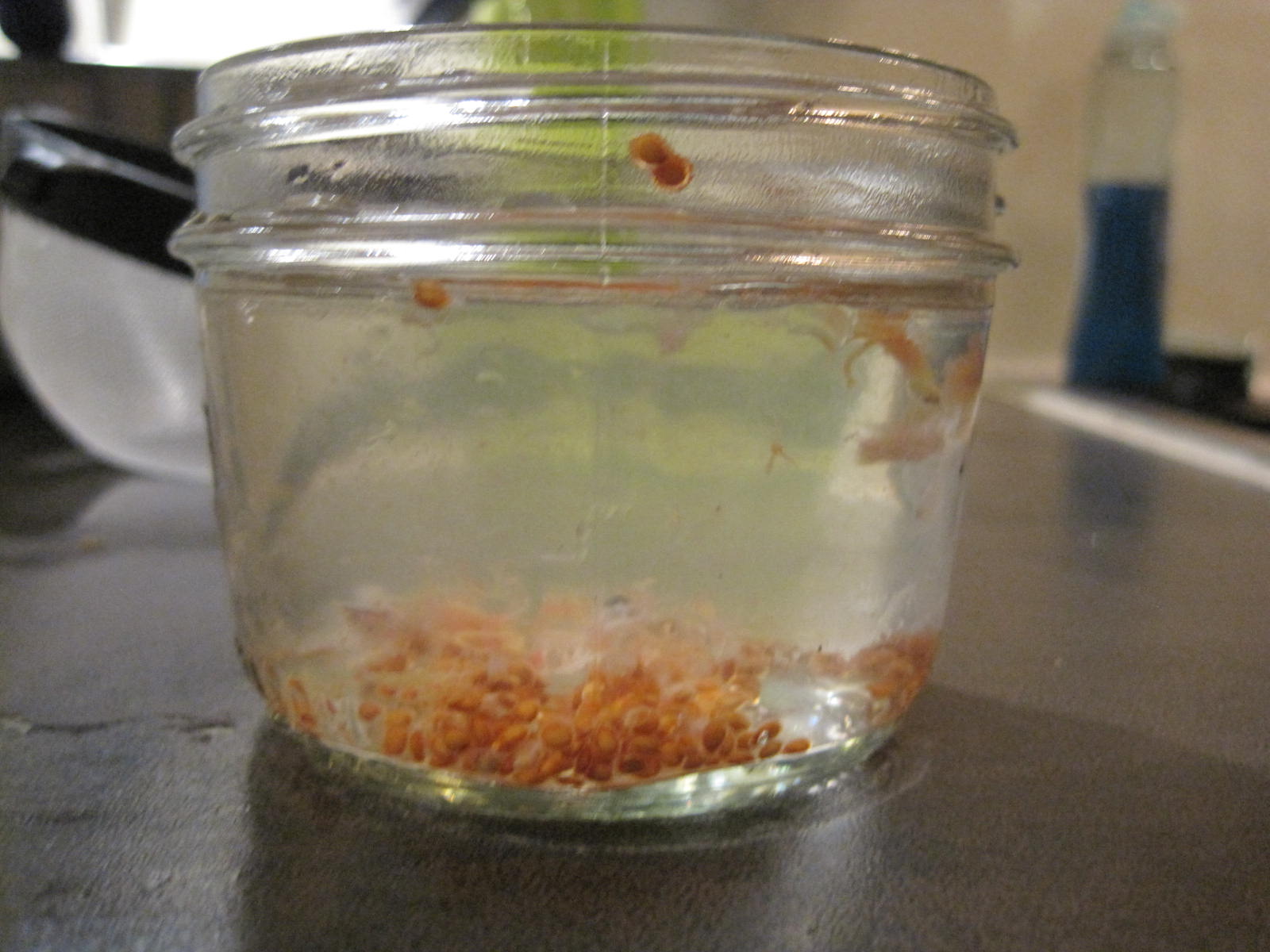
Place the jelly and seeds into a small jar or glass. (Add a little water if you are processing only one or two small tomatoes.) Loosely cover the container and place in a warm location, 60-75° F. for about three days. Stir once a day. We forgot to stir. Whoops.
 

A layer of fungus will begin to appear on the top of the mixture after a couple of days. This fungus not only eats the gelatinous coat that surrounds each seed and prevents germination, it also produces antibiotics that help to control seed-borne diseases like bacterial spot, canker and speck. What they didn't say was that this fungus smells really bad (kind of like moldy cheese). The red tomato had bigger pieces so it developed a fungal layer much more quickly than the smaller yellow ones.


Here they are after 4 or 5 days. We couldn't get to them right away so they may have sat longer than they should have. Again, whoops. 

 
After three days fill the seed container with warm water.


 Let the contents settle and begin pouring out the water along with pieces of tomato pulp and immature seeds floating on top. Note: Viable seeds are heavier and settle to the bottom of the jar. I thought the instructions were wrong because if I poured out the contents I thought the seeds would also slip out. So instead I tried to spoon off the mold. Ugh. It was gross and didn't work. I finally did as the instructions advise and just poured and lo and behold the icky stuff poured right out with no fuss.

 Repeat this process until water being poured out is almost clear and clean seeds line the bottom of the container. Pour these clean seeds into a strainer that has holes smaller than the seeds. Let the excess water drip out and invert the strainer onto paper towel or piece of newspaper.  We didn't have a strainer fine enough so I just poured out as much water as I could and then poured the rest through a paper towel. This worked just fine.


Allow the seeds to dry completely (usually a day or two).


Break up the clumps into individual seeds, label and store in a packet or plastic bag. I didn't realize the seeds would have a little furry coating. I took out some packet tomato seeds to compare and sure enough, they also have a furry coating. This produced a remarkable amount of seeds. We will have enough for years to come, but if we have a particularly good year with these next year I may do this process all over again to keep breeding stronger performers. 


Reflections on Seed Saving:

I can't yet comment on the vitality of the seed (will follow up this summer) but the process definitely made me feel like I am contributing to the ongoing story of our planet's food legacy, particularly by saving seeds from the volunteer tomato. To be an heirloom an OP seed needs to be between 30-50 years old by most definitions but usually getting to heirloom status means that a plant worked particularly well in one part of the country for a long time. This tomato plant appeared in our garden unexpectedly but was so successful we wanted to save it to try again. In Michael Pollan's Botany of Desire terms, this plant "used" us to help it procreate by offering us something we wanted: an abundance of tasty fruit. If we are still using it in 30 years Seed Savers Exchange may even want some of them :)

Rosalind Creasy's, the author of Cooking from the Garden and quoted in the Jan/Feb 2013 issue of Urban Farm, description of what would go on SSE packets if there were space sums up my feeling nicely: "By planting the seeds in this packet, you have become a steward of our food heritage, a link in a chain that goes back thousands of years. Use his seed to grow food, but please save the seeds, share them with others and replant them again in your garden to allow the seed to adapt to your local growing conditions."

Monday, December 10, 2012

December Harvests

Sorry everyone for the long blogging break. What can I say? Babies keep a person busy. But I thought I'd share some December gardening harvest pictures (that's right, December harvests). We are having unseasonably warm weather and that, plus our rowcover is giving us a continued harvest of yummy veggies including red and green mustard, onions, cylindra beets, radishes, and lettuce (including my new favorite Merveille des Quatre Saisons or Marvel of the Four Seasons).